29.8.13

Marcion of Sinope - Wikipedia, the free encyclopedia

Marcion of Sinope - Wikipedia, the free encyclopedia


Marcion of Sinope[pronunciation?] (Greek: Μαρκίων[1] Σινώπης), (c.85 – c.160) was a bishop in early Christianity.[2]

His theology, which rejected the deity described in the Jewish Scriptures as inferior or subjugated to the God proclaimed in the Christian gospel, was denounced by the Church Fathers and he was excommunicated. He is often considered to have held a pivotal role in the development of the New Testament canon.

Life

Hippolytus records that Marcion was the son of the bishop of Sinope, in Pontus. His near-contemporaries Rhodo and Tertullian described him as a wealthy ship owner,[3] and he is said to have made a donation of 200,000 sesterces to the church. Marcion probably was consecrated a bishop, likely an assistant or suffragan of his father at Sinope.[3]


Conflicts with the bishops of Rome arose and he was eventually excommunicated by the Church of Rome, his donation being returned to him. After his excommunication, he returned to Asia Minor where he continued to lead his many church congregations and teach the Christian gospel in its Marcionite version.

In 394, Epiphanius claimed that after beginnings as an ascetic, Marcion seduced a virgin and was accordingly excommunicated by his father, prompting him to leave his home town.[4] This account has been doubted by many scholars, who consider it "malicious gossip". More recently, Bart D. Ehrman suggests that this "seduction of a virgin" was a metaphor for his corruption of the Christian Church, with the Church portrayed as the undefiled virgin.[5]

Teachings

Study of the Jewish Scriptures, along with received writings circulating in the nascent Church, led Marcion to conclude that many of the teachings of Jesus were incompatible with the actions of the god of the Old Testament, Yahweh. Marcion responded by developing a dualist system of belief around the year 144.[6] This dual-god notion allowed Marcion to reconcile supposed contradictions between Old Covenant theology and the Gospel message proclaimed by Jesus.

Marcion affirmed Jesus to be the saviour sent by the Heavenly Father, and Paul as his chief apostle. In contrast to the nascent Christian church, Marcion declared that Christianity was in complete discontinuity with Judaism and entirely opposed to the Old Testament message.

Marcion did not claim that the Jewish Scriptures were false. Instead, Marcion asserted that they were to be read in an absolutely literal manner, thereby developing an understanding that YHWH was not the same god spoken of by Jesus. For example, Marcion argued that the Genesis account of YHWH walking through the Garden of Eden asking where Adam was proved YHWH inhabited a physical body and was without universal knowledge (omniscience), attributes wholly incompatible with the Heavenly Father professed by Jesus.

According to Marcion, the god of the Old Testament, whom he called the Demiurge, the creator of the material universe, is a jealous tribal deity of the Jews, whose law represents legalistic reciprocal justice and who punishes mankind for its sins through suffering and death. Contrastingly, the god that Jesus professed is an altogether different being, a universal god of compassion and love who looks upon humanity with benevolence and mercy. Marcion also produced his Antitheses contrasting the Demiurge of the Old Testament with the Heavenly Father of the New Testament.

Marcion held Jesus to be the son of the Heavenly Father but understood the incarnation in a docetic manner, i.e. that Jesus' body was only an imitation of a material body, and consequently denied Jesus' physical and bodily birth, death, and resurrection (e.g., he accepted Luke's Gospel yet eliminated portions such as the birth narrative) and thereby denied the historic Christian Gospel (1 Cor 15:3-4).

Marcion proposed his unique New Testament canon. His canon consisted of only eleven books grouped into two sections: the Evangelikon, being a version of the Gospel of Luke,[7] and the Apostolikon, a selection of ten epistles of Paul the Apostle, whom Marcion considered the correct interpreter and transmitter of Jesus' teachings. From this selection of New Testament books he eliminated elements relating to Jesus' birth, childhood, Judaism, and material challenging Marcion's dualism.

Marcion and Gnosticism

Marcion is sometimes described as a Gnostic philosopher. In some essential respects, Marcion proposed ideas which would have aligned well with Gnostic thought. Like the Gnostics, he argued that Jesus was essentially a divine spirit appearing to men in the shape of a human form, and not someone in a true physical body.[8]

However, Marcionism conceptualizes God in a way which cannot be reconciled with broader Gnostic thought. For Gnostics, every human being is born with a small piece of God's soul lodged within his/her spirit (akin to the notion of a 'Divine Spark').[8] God is thus intimately connected to and part of His creation.[8] Salvation lies in turning away from the physical world (which Gnostics regard as an illusion) and embracing the God-like qualities within yourself.[8] Marcion, by contrast, held that the Heavenly Father (the father of Jesus Christ) was an utterly alien god; he had no part in making the world, nor any connection with it..[8]

Legacy

In 144, Marcion became one of the first declared heresiarchs for his deviations from the orthodox viewpoints of the apostolic church. The suppression of the Marcionist form of Christianity is thus viewed[9] as a catalyst for the development of the New Testament canon, the establishment of a centralised church law, and the structuring of the Church.

The church that Marcion founded had expanded greatly within his lifetime, and was a rival to the orthodox Christian church. Its adherents were strong enough in their convictions that the Marcionite church retained its following for more than a century. It survived Christian controversy, and imperial disapproval, for several centuries more.[10]

Marcion proposed and delineated a canon (a list of officially sanctioned religious works). This prompted the orthodox, apostolic church to form an official canon of books that had been recognized as divinely inspired and authoritative. Christians began to divide texts into those that aligned with the "measuring stick" (Greek kanōn literally means "measuring stick") of being an apostolic, authoritative, Christian writing (the works of New Testament as we know them today), those that were to be rejected as heretical or pseudonymous, and those that were able to be accepted but not to be seen as canon or read in public gatherings (e.g., The Shepherd of Hermas). Therefore, Marcion played a role in finalising the structure and contents of the collection of works now called the New Testament.

Notes

  1. ^ http://khazarzar.skeptik.net/books/justinus/apolog1g.htm
  2. ^ Tertullian, "Adversus Marcionem" book 1.
  3. ^ a b Catholic Encyclopedia, "Marcionites" (1911).
  4. ^ Haeresies, XLII, ii.
  5. ^ Bart D. Ehrman,Lost Christianities
  6. ^ 115 years and 6 months from the Crucifixion, according to Tertullian's reckoning in Adversus Marcionem, xv.
  7. ^ Joseph B. Tyson (Marcion and Luke-Acts: A Defining Struggle) contradicts the mainstream view of Marcion's gospel being based on Luke, opining instead that canonical Luke may be a response to Marcion's gospel.
  8. ^ a b c d e Adolph Harnack, Marcion: The Gospel of the Alien God (1924).[page needed]
  9. ^ "The Canon of Scripture" by F.F. Bruce 1988, page 151
  10. ^ Evans 1972 p. ix

References

  • Blackman, E.C. Marcion and His Influence 2004 ISBN 1-59244-73
  • Clabeaux, John James. The Lost Edition of the Letters of Paul: A Reassessment of the Text of Pauline Corpus Attested by Marcion (Catholic Biblical Quarterly Monograph Series No. 21) 1989 ISBN 0-915170-20-5
  • Dahl, Nils Alstrup. "The Origin of the Earliest Prologues to the Pauline Letters", Semeia 12 (1978), 233-277
  • Epiphanius of Salamis. The Panarion of Epiphanius of Salamis, Book 1 (Sects 1-46) Frank Williams translator, 1987 ISBN 90-04-07926-2
  • Evans, Ernest (comments and translation): Tertullian, Against Marcion (Oxford University Press, 1972). E-text of Adversus Marcionem and Evan's introduction "Marcion : His Doctrine and Influence"
  • Grant, Robert M. Marcion and the Critical Method Peter Richardson & John Collidge Hurd, eds., From Jesus to Paul. Studies in Honour of Francis Wright Beare. Waterloo, ON, 1984. p. 207–215.
  • Harnack, Adolf von 1961. History of Dogma (Neil Buchanan, translating Harnack's Dogmengeschichte 1900), vol I, pp 267 – 313, vol II, pp 1 – 19
  • Harnack, Adolf von. Marcion: The Gospel of the Alien God translation 1990 ISBN 0-939464-16-0
  • R. Joseph Hoffmann. Marcion, on the Restitution of Christianity: An Essay on the Development of Radical Paulist Theology in the Second Century 1984 ISBN 0-89130-638-2
  • Knox, John. Marcion and the New Testament 1942 ISBN 0-404-16183-9
  • Francis Legge, Forerunners and Rivals of Christianity, From 330 B.C. to 330 A.D. (1914), reprinted in two volumes bound as one, University Books New York, 1964. LC Catalog 64-24125.
  • Livingstone, E.A. The Oxford Dictionary of the Christian Church (3rd ed.), pp. 1033–34, 1997 ISBN 0-19-211655-X
  • Riparelli, Enrico, Il volto del Cristo dualista. Da Marcione ai catari, Peter Lang, Bern - Berlin - Bruxelles - Frankfurt am Main - New York - Oxford - Wien 2008, 368 pp. ISBN 978-3-03911-490-0
  • Williams, David Salter. "Reconsidering Marcion's Gospel", Journal of Biblical Literature 108 (1989), p. 477-96
  • Wilson, R. S. Marcion: A Study of a Second-Century Heretic (London:Clarke) 1933

External links

31.7.13

Death is the ultimate Big Unknown - Introduction to Gnosis #42

Introduction to Gnosis #42

The Big Unknown

by Jay Kinney

Despite the recent popularity of books detailing near-death experiences and the host of channeled entities who assure their listeners that life continues beyond the Big Divide, death is not something that most of us look forward to. And with good reason: testimonials aside, there is no way of knowing with certainty what awaits us when our time has come. Death is the ultimate Big Unknown, and most of our theories and beliefs regarding it amount to whistling in the dark.

The ruling cosmology of the modern era assumes that death is life's enemy - that we get one shot at life and when it ends, the party's over. This assumption fuels much of the anxiety of Western culture and underlies everything from free-floating existential despair to a preoccupation with antioxidants and life extension.

To make matters worse, AIDS has come along, causing friends and loved ones to waste away before our eyes. That some of the stricken rage against their fate is no surprise, but I've been most struck by the dignity of those who calmly look death in the eye and beckon to the rest of us to share their gaze. It is one of life's ironies (or is it death's?) that two of the most luminously transparent and saintly people I've ever had the privilege to know were a drag queen and a Satanist in the drawn-out final stages of AIDS. Death the leveler serves double time as a saintmaker as well.

In any case, if we can extract ourselves from the hurly-burly of the race against the clock long enough to survey the spiritual landscape, an interesting fact emerges. Nearly every religion, whether mono- or polytheistic, whether Eastern or Western, affirms the continuity of life after death. Of course the cynic will say that this is merely because every religion is engaged in selling pie in the sky and priests of every stripe know a good scam when they see one. However, I think this is too easy an answer.

True, reality is flexible enough to provide most every believer with evidence in support of his own beliefs, but the sheer redundancy of multiple pointers towards an afterlife should lead us to suspect that there may be some truth here.

But which truth? A succession of earthly lives? A progression through ever more rarefied dimensions? A cannon shot towards heaven or hell? Or perhaps the chummy continuity of ongoing family relations between the Seen and the Unseen?

The Sufis speak of dying before you die, an initially mysterious dictum that has at least two meanings. The first is a recipe for mystical attainment: "die" to the things of this world (that is, become nonattached) before death does the detaching for you! According to tradition, this discipline elevates the mystic's consciousness while living and assists his salvation after death.

The second meaning, however, is less apparent. It refers to one of the fruits of mystical attainment: the capacity to experience the continuity of consciousness beyond death. If one has experienced this "dying before you die," which has been likened to "the drop joining the ocean," death is no longer an unknown or a source of dread. One has participated in the awareness that extends into the unseen and needs no scientific proof to confirm that life offers a wider spectrum of being than is generally assumed. The mystic who has truly undergone this "death," without becoming mired in either his own delusions or the subtle realms, becomes truly alive.

So far, so good. But there is another common element among the teachings of various religions regarding death. This is the concept of a day of judgment (a la Christianity and Islam), or the weighing of the soul (as in ancient Egyptian religion), or a karmic reckoning (as posited in Hindu and Buddhist teachings). Even if death doesn't mean the end of life per se, it seems to represent a shift in our existence that is shaped by our deeds and frame of mind in this present life.

This is perhaps the real source of our wariness of death, for who doesn't suspect, deep down, that judged by objective standards of moral conduct, we will all come up short? The specter of an eternity of torment in hell can be profoundly discouraging, while the promise of a ticket to heaven may seem about as likely as winning the state lottery. Here too, esoteric teachings offer insights. The soul upon death is said to commence a journey through veils (or bardos or worlds) which prove beguiling in direct proportion to our earthly fixations. Thus the value of prayers for the dead, and the promise of liberation for those who maintain their connectedness with the Absolute.

All of which sounds rather rarified to most of us and still leaves us wondering as to what attitude to take towards our own impending death. Gleeful anticipation seems rather optimistic, yet morbid dread seems self-defeating. My own solution may be naive, but it is the best I have to offer at this point. And that is, unremarkably enough, simply do the best you can and leave the outcome to God's mercy. A life of good deeds that are performed with the intention of eternal felicity may rank no higher in the final estimate than a life of well-meaning mistakes that are sincerely undertaken with no grand goal in mind. I am of the school that assumes, perhaps heretically, that everyone is redeemed in the end - even Satan.

Some of the greatest mystics have taught this and I've come upon no reason to dispute their findings. But ultimately it is an open question. As far as our personal journey goes, the salient point to keep in mind may be the sobering fact that death can come unbidden at any moment. As such it remains a spur, not unlike a high-school "pop quiz," to keep our wits about us and maintain a link with the spiritual life. If death is not the final chapter, then it may just be one stage of a work in progress, and deserves better consideration than a mere fait accompli. We dedicate this issue to that possibility.

Prosperity gospel makes a mockery of Christianity | Andrew Brown | Comment is free | theguardian.com

The prosperity gospel makes a mockery of Christianity | Andrew Brown | Comment is free | theguardian.com

Preachers who get rich by saying success is a mark of divine favour go against what Jesus taught – maybe he had a point
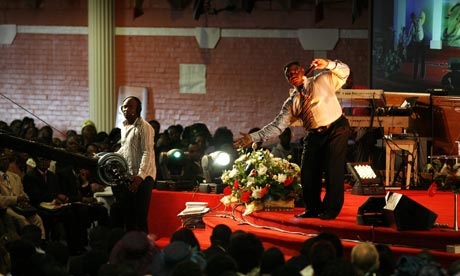
Pastor Matthew Ashimolowo
London pastor Matthew Ashimolowo was ordered to repay £200,000 after it emerged he used church assets to buy a £13,000 Florida timeshare and spent £120,000 on his birthday celebrations, including £80,000 on a car. Photograph: David Levene
There is a very good programme on the "prosperity gospel" available on the Radio 4 website right now. Two things need saying about it. The first is that it proves, if anything could, the difficulty of defining religions in terms of their doctrine. Prosperity gospellers pretend to be Christian, but their teaching seems to me absolutely antithetical to everything that makes Christianity worth considering.

What they teach is that God loves and rewards his faithful servants with earthly goods. In practice, the way to do this is to shun the company of losers and hand over 10% of your earnings to the pastor. The riches he accumulates are then a sign that God has blessed him, which means that he is capable of passing on these mighty blessings to you.

The crass horror of these people and their exploitation of the poor and miserable hardly needs stressing. The Charity Commission investigated the church of one of the most successful practitioners in England, Matthew Ashimolowo, after his congregation brought him a timeshare apartment and a Mercedes for one birthday – or at least found that this was what their offerings had been spent on. The American versions are even richer and more repulsive.

Oddly enough, I don't think Jesus would have been too worried by tithing. It was a duty laid on the pharisees of his period and his objection there was that they were hypocrites, and thought that money and scrupulous showy observance could substitute for inner devotion to God, not that they tithed at all. But the idea that you should only mix with successful people, or that success itself is a mark of divine favour, goes completely against his actions as well as his teachings.

Ever since the dawn of monotheism these things have been known to be untrue. Robert Bellah records a fragment, at least 3,000 years old, known as the Babylonian theodicy: "Those who do not seek the God go the way of prosperity, while those who pray to the Goddess become destitute and impoverished."

The whole of the Hebrew Bible, or Old Testament, can be read as a record of people coming to terms with failure. In part this was done by the invention of a heroic past, in the empire of Solomon's time, something that may have been one of the truly great mistakes of history. But it is also directly addressed, in numerous psalms, in Ecclesiastes, and above all in the Book of Job.

Jesus himself took on the mantle of the suffering servant, and was seen by his followers as the fulfilment of that prophecy.

For all those reasons, it is impossible for me to regard the prosperity gospel as Christian. But who is to decide what counts as Christian, or as Muslim for that matter? These are inevitably judgments of value about matters of interpretation. They can't be settled by reference to the scriptures involved and if you look for easy answers there you will find far too many.

Whether or not the prosperity gospel is Christian, the other question to arise is whether it's harmful. The congregations are almost entirely made up of black people in this country, especially west Africans, and poor people in the US, where there is an extraordinary swamp of such teachings. In any case it's an easily observed paradox that those most in need of wealth are least likely to be able to afford tithes.

But at the same time, you might ask what else they might spend the money on. The services themselves are a tremendous rush of energy and fun, like a drug that leaves no hangover and is not even very addictive. While the music lasts, you can dance and sing and forget all your troubles. And there is this to be said for religion as a sort of opium: it doesn't destroy your health. It may be a much less damaging escape from the world. In the BBC programme, the pastor made the point that these churches encourage optimism and that need not always be cruel. Of course, this is little consolation if you are in fact old, unemployable, ill, or the kind of disgusting loser that Jesus might have hung out with. But those people aren't the target market at all.

For young, healthy, anxious strivers who need reinforcement in the face of discouragement, the prosperity gospel is a much less harmful way of escaping the world than either drugs or gambling, and will not make them nearly as poor as those do, even if it never makes them rich.

But no matter how I argue that these rites may be largely harmless when practised by consenting adults, I still find them disgusting. It matters that they aren't a form of real Christianity, which shows how hard it is to rid myself of the nagging suspicion that Jesus was telling the truth.

4.6.13

Religion the Disease of Humanity - brainwashing the children


Religion the Disease of Humanity - CONTROVERSIAL

Published on 3 Mar 2013
SHOCKING RELIGIONS.MUST SEE!!!Christians,Jews,Muslims.Make your own mind about religions after watching this video.Don't forget to rate & comment !

28.5.13

'Life's Purpose' author Eckhart Tolle is serene, critics less so - USATODAY.com

'Life's Purpose' author Eckhart Tolle is serene, critics less so - USATODAY.com

Bill Maher's political monologues delight him, and he laughed at his film Religulous "because there really are a lot of weird beliefs out there." The trouble with Maher, Tolle says, is "while he sees the absurdity of religious expressions, he misses the values they point toward."

In Tolle's view, "religion and ritual can be vehicles for entering stillness. It says in Psalm 46:10, 'Be still, and know that I am God.'

"But they are still just vehicles. The Buddha called his teaching a raft: You don't need to carry it around with you after you've crossed the river."

Tolle quotes often from the Bible, from Christianity and Buddhism, and half a dozen other world religions. But the words of Buddha and Jesus take a unique Tolle spin. For example, "Your thought identity, your words, are ultimately illusionary. Jesus knew this when he talked about 'deny thyself.' Most Christians do not fully understand what that means. It means 'no self.' Buddha, too, recognized the inherent unreality of our self-image" he says.

By submitting yourself to this thought-free state, you can finally recognize "The Truth" within yourself — that you already have all the joy, creativity, energy, love you seek. You possess all the higher power, you reach your own heaven, he says.

"Was Jesus the son of God?" he asks rhetorically. "Yes. But so are you. You just haven't realized it yet."

That inflames critics like the bloggers at Christian Skepticism, who call Tolle the Antichrist. 

26.5.13

Atheists Can Now Go To Heaven - Pope Francis rocked some religious ...

Atheists Can Now Go To Heaven - YouTube: "Pope Francis rocked some religious and atheist minds today when he declared that everyone was redeemed through Jesus, including atheists."

25.5.13

Ricky Gervais "PrayForOklahoma" Tweet Controversy - YouTube


Published on 23 May 2013
"While many Americans have taken to Twitter to send out thoughts and prayers to the victims of the Oklahoma tornado, comedian Ricky Gervais urged users of the social media site to actually do something for them."*

Ricky Gervais poked fun at celebrities like Katie Perry, Beyonce, and Rihanna for praying for Oklahoma, pointing out that actually doing something for tornado victims is preferable. And...it landed him in a bit of trouble.

Cenk Uygur and Ana Kasparian discuss.

*Read more from Yahoo:
http://movies.yahoo.com/news/ricky-ge...